Meno Pause, Carry On
When life pauses, but you don't. Menopause is a biological transition — not the end of your story, your ambition or your sense of yourself.

Key Takeaways
- Menopause is a natural biological stage, not a disease.
- Symptoms, and how strongly they are felt, vary substantially between women.
- You do not have to endure symptoms simply because menopause is natural.
Life rarely asks permission before it changes. A woman can be building a career, raising children, caring for ageing parents, holding a relationship together, chasing something she has wanted for years — and somewhere in the middle of all that motion, her body begins to change in ways nobody put on the calendar.
This is the pause she never scheduled.
The pause may be real. The changes may be real. But the woman is still moving forward.
Welcome to the pause
The word itself gives the game away. Meno comes from the Greek for month — the monthly cycle. Pause means exactly what it sounds like. Together they describe a stopping of the monthly rhythm a woman may have known for thirty or forty years.
Clinically, menopause is a single point in time rather than a season. The World Health Organization describes natural menopause as having occurred after twelve consecutive months without menstruation, where there is no other obvious physiological or medical cause. You only know you have passed it by looking back.
Three words get used almost interchangeably, and it helps to separate them:
- Perimenopause: the transition leading up to menopause. The WHO describes it as beginning when the first signs appear — usually changes in the menstrual cycle — and ending one year after the final period.
- Menopause: the milestone itself. The final menstrual period, confirmed only in hindsight.
- Postmenopause: the years that follow that milestone.
Most women reach menopause between the ages of 45 and 55, as a natural part of biological ageing. But timing varies, and it can arrive earlier — sometimes much earlier.
The pause you didn't schedule
Menopause has poor timing. It tends to arrive when a woman is already carrying a great deal: work that demands her attention, children who still need her, parents who are beginning to need her more, a relationship that deserves better than her leftover energy.
The changes women describe during this transition can include:
- Hot flushes and night sweats: among the most commonly reported changes of the menopausal transition.
- Changes in the cycle: during perimenopause, periods often become irregular in timing and flow before stopping altogether.
- Difficulty sleeping: sometimes tied to night sweats, sometimes not.
- Changes in mood: including low mood and anxiety.
- Intimate changes: vaginal dryness, discomfort during sex, and changes in bladder control.
- Feeling mentally foggy: many women describe difficulty concentrating or reaching for words, though this is reported more variably than other changes.
Here is the part that often gets lost: these experiences vary substantially from person to person. Some women pass through this transition noticing very little. Others find it reshapes their daily life for a time. Neither is doing it wrong. And not every change a woman notices in her forties and fifties is caused by menopause — which is exactly why it is worth asking rather than assuming.
When your body feels unfamiliar
The symptom lists are the easy part. What they rarely capture is the stranger feeling underneath — that your body has changed its terms without consulting you.
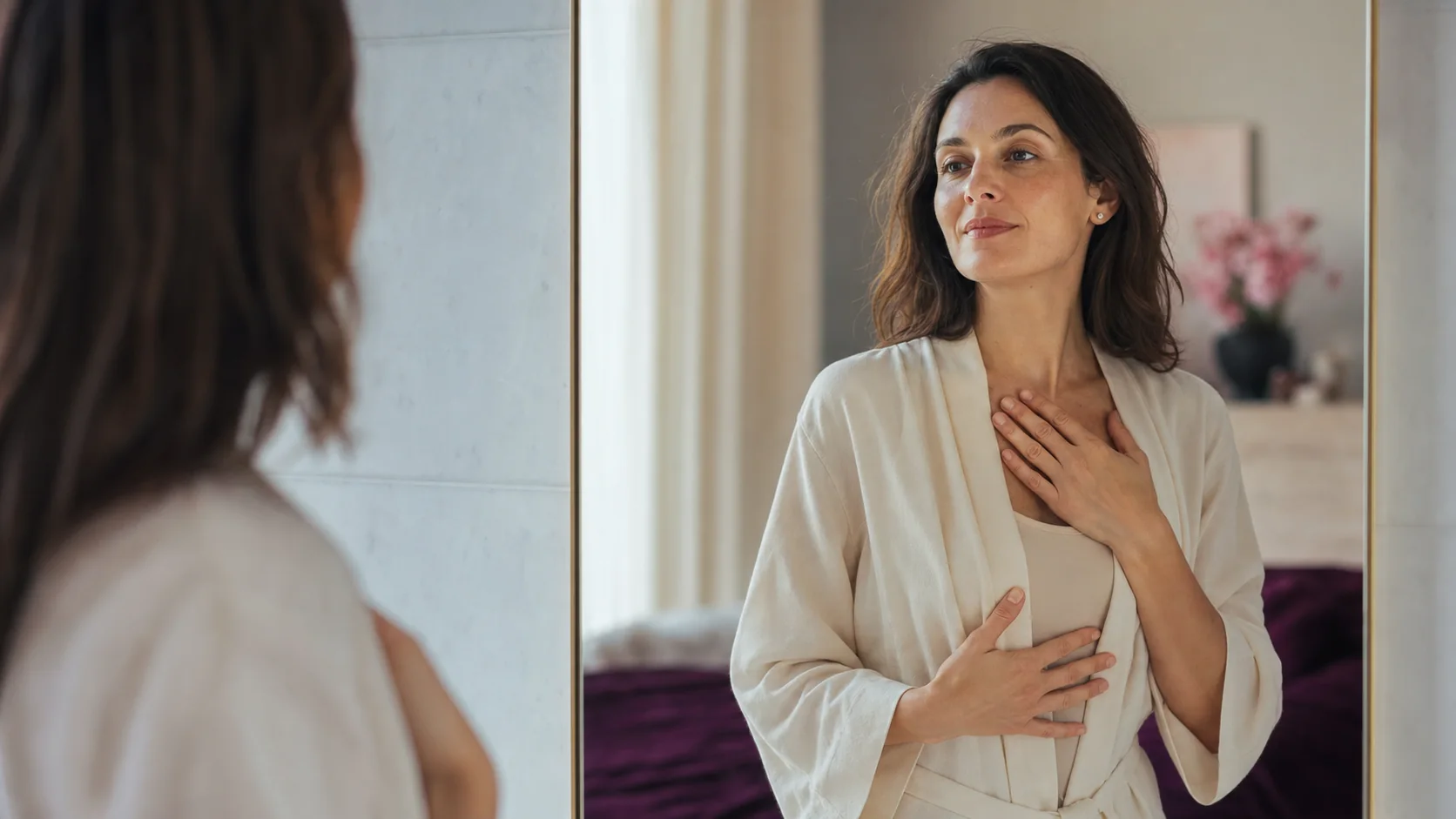
Women describe looking in the mirror and finding someone slightly unfamiliar looking back. Feeling less certain in a room they used to own. Wondering whether what they are noticing is menopause, or ageing, or stress, or nothing at all. Being tired of being tired. Finding it oddly difficult to say the words vaginal dryness out loud, even to a doctor, even though it is a medical fact and not a confession.
And underneath all of it, a quiet expectation from the world that she should simply get on with it.
You are allowed to notice that something has changed. You are allowed to ask questions. You are allowed to want support.
Menopause does not make you less of a woman
There is an old story about this stage of life, and it deserves to be put down.
It says that beauty has an expiry date. That desire belongs to younger women. That ambition should start winding down. That a woman who is no longer fertile is somehow less, as though motherhood were the whole of her. That her relevance thins with every year, and that her best work is already behind her.
None of that is medicine. It is folklore, and not even kind folklore.
What actually happens is narrower and far less dramatic: the ovaries stop releasing eggs, hormone levels change, and menstruation ends. That is a biological transition. It is not a verdict on a woman's worth, her desirability, her intelligence, her authority or her future.
Menopause marks the end of menstruation. It does not mark the end of womanhood.
The pause can affect more than your body
When sleep is broken for months, everything downstream of sleep becomes harder — concentration at work, patience with a teenager, warmth towards a partner. When intimacy becomes uncomfortable and nobody talks about it, distance can grow quietly in a relationship that was otherwise fine.
The honest version is this: menopause is not the cause of every difficulty a woman faces in midlife, and it is unfair to her to pretend that it is. But symptoms can affect wellbeing and daily life, and when they do, that effect is real and worth taking seriously rather than absorbing in silence.
There is no prize for suffering quietly
Somewhere along the way, women were taught that because menopause is natural, it must simply be endured. Thirst is natural too. We still drink water.
If what you are experiencing is affecting your sleep, your work, your relationships or how you feel in your own life, that is reason enough to raise it with a healthcare professional. Not because something has gone wrong with you, but because support exists and you are entitled to ask about it.
Approaches that may be discussed include lifestyle changes, non-hormonal medicines, talking therapies such as cognitive behavioural therapy, and hormone replacement therapy. HRT helps many women and is not right for everyone — what suits you depends on your symptoms, your medical history and your own preferences. That is a conversation to have with a qualified healthcare professional who knows your history, not a decision to be taken from an article.
It helps to arrive prepared: note what you are experiencing and how often, how it is affecting your days, what you have already tried, and what you most want to change. Vague symptoms are easy to dismiss. Specific ones are harder to wave away.
What if the pause is asking you to listen?
There is another way to read all of this. Not as something happening to you, but as something finally getting your attention.
Most women spend decades attending to everyone else's needs with great skill and very little rest. A body that suddenly insists on being noticed is, in its blunt way, asking a question.
- What does my body need now, rather than what it needed at thirty?
- What have I been ignoring because I was simply too busy?
- What have I been afraid to ask a doctor out loud?
- What would feeling well actually look like for me now?
- What parts of myself have been on hold, and for how long?
- What do I want the next chapter to look like?
These are not questions with tidy answers. They are questions worth sitting with.
Carry on
Carry on does not mean pretending nothing has changed. That was the old advice, and it asked women to perform wellness instead of actually having it.
It means carry on differently, if differently is what this season asks for. Carry on better informed. Carry on with support rather than without it. Carry on knowing your own body more honestly than you did at twenty-five. Carry on with permission to change your mind, your pace and your priorities. Carry on with your ambitions entirely intact.
Meno pause. Take the breath. Listen to your body. Ask the questions. Get the support. Learn what is happening to you.
And then carry on.
The pause was never the end of your story. It was simply a moment between chapters.
A note on menopause
- Menopause is a natural biological stage, not a disease.
- Natural menopause most commonly occurs between the ages of 45 and 55, although timing varies.
- Perimenopause can begin years before the final menstrual period, usually with changes to the cycle.
- Menopause is identified in hindsight, after twelve consecutive months without menstruation where there is no other obvious cause.
- Symptoms, and how strongly they are felt, vary substantially between women.
- Menopause can affect physical, emotional, mental and social wellbeing.
- Menopause can also be induced by surgery that removes both ovaries, or by treatments such as chemotherapy or radiotherapy.
When to talk to a healthcare professional
Consider speaking to a qualified healthcare professional if symptoms are affecting your sleep, your work, your relationships, your daily activities, your emotional wellbeing or your quality of life. You do not need to wait until things become unbearable in order to be taken seriously.
Sources
Sources & Additional Resources
To ensure this guide remains accurate and reliable, the Evelyn Editors referenced the following clinical frameworks:
- Global Health Standards: World Health Organization (WHO) Guidelines.
- Clinical Diagnostic Data: Leading international Obstetric and Gynaecological Consensus criteria.
- Local Healthcare Frameworks: National Department of Health Guidelines for Maternity Care.
Referenced in this guide
- World Health Organization. Menopause fact sheet
- National Institute on Aging. What Is Menopause?
- NHS. Menopause and perimenopause
- NHS. Menopause and perimenopause: treatment
- NHS. Postmenopausal bleeding
Content is for education and empowerment. It complements — never replaces — advice from your own healthcare professional.
Published by the Evelyn Editors.