Strength After Fifty: Why Lifting Is the Best Menopause Medicine You're Not Taking
Oestrogen decline accelerates muscle and bone loss — and resistance training is the most powerful countermeasure we have. It is never too late to start.
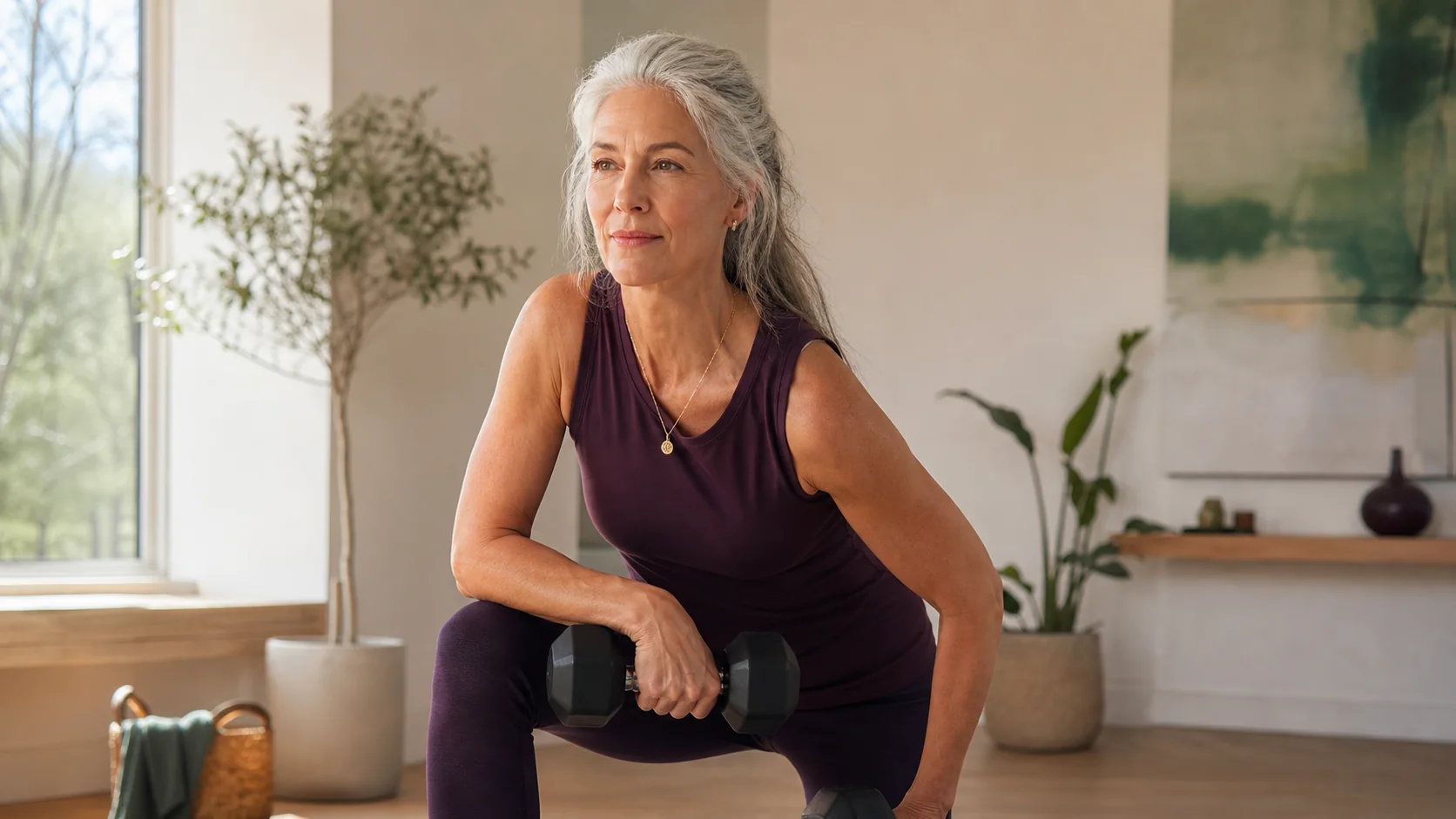
Key Takeaways
- Oestrogen decline can accelerate muscle and bone loss.
- Progressive resistance training supports strength, bone density and metabolic health.
- Starting small and progressing gradually is enough to begin.
Around menopause, women lose muscle and bone at a pace that would alarm us in any other context. Oestrogen is quietly anabolic — it supports muscle repair and bone remodelling — and its decline shows up as sarcopenia, stiffening joints, and the osteoporosis that fractures one in three women over fifty. Here is the good news, and it is genuinely good: resistance training pushes back on every one of those fronts.
What the evidence shows
Progressive resistance training in midlife and beyond increases muscle mass and strength, maintains or improves bone density at the spine and hip, improves insulin sensitivity, reduces falls, and has meaningful effects on mood, sleep and hot flush burden. No supplement, and few medications, can match that portfolio. And the response is preserved with age — studies show significant strength gains in women in their seventies and eighties starting from scratch.
Frailty is not a birthday. It is a trajectory — and trajectories can be trained.
Starting safely, starting anywhere
- Two to three sessions a week of major-muscle work — squats, hinges, pushes, pulls, carries — is the evidence-based dose
- Bodyweight, bands, bottles of water: the muscle does not know what brand the resistance is
- Progress the load gradually — the ‘progressive’ in progressive resistance is where bone benefits live
- Add impact where joints allow — brisk walking, stair climbing, gentle hops — for extra bone signal
- A session or two with a professional to learn patterns is a worthwhile investment, especially with osteoporosis or prolapse
Women who begin strength work in midlife often describe the same shift in different words: strength changes how they carry groceries, grandchildren and themselves. You are not too old, it is not too late, and you do not need permission. Pick up something heavy, put it down with intention, and repeat for the rest of your long, strong life.
References
Sources We Trust
- Watson SL, et al. High-intensity resistance and impact training improves bone mineral density in postmenopausal women: the LIFTMOR trial. Journal of Bone and Mineral Research. 2018;33:211–220.
- Fragala MS, et al. Resistance training for older adults: NSCA position statement. Journal of Strength and Conditioning Research. 2019;33:2019–2052.
- International Osteoporosis Foundation. Facts and statistics; 2024.
Educational note
This article supports education and empowerment. It does not replace personalised medical advice, diagnosis or treatment from your own healthcare professional.